
Real estate, Tier 3 market, customer experience architecture
MR Constructions
Making a builder feel premium before it sells a single home.
- Client
- MR Constructions
- Category
- Real estate
- Engagement
- Repositioning and brand architecture
- Structure
- 4 phases

01The problem
What was actually broken
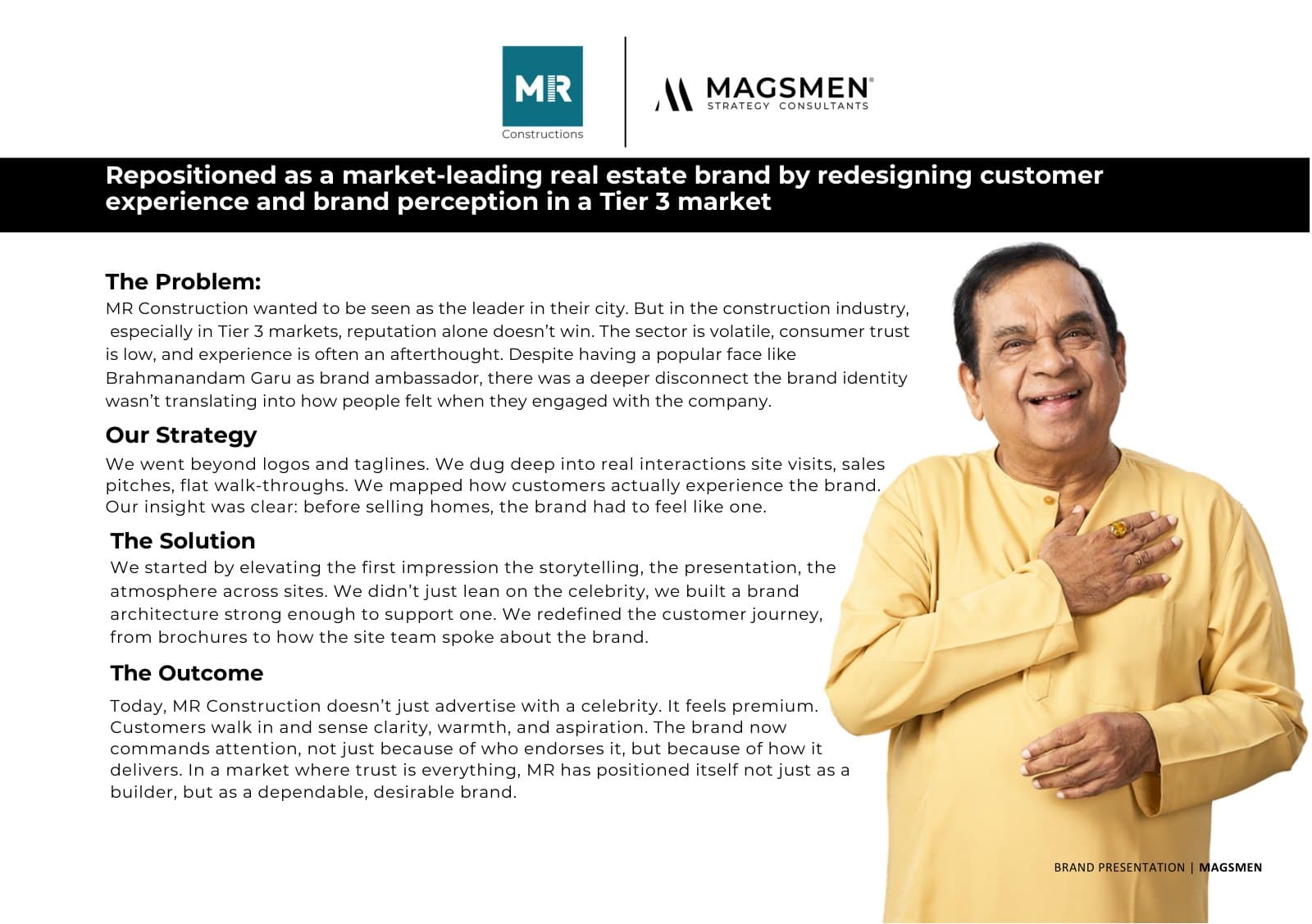
MR Construction wanted to be the clear leader in their city, and they had something competitors did not: Brahmanandam Garu as brand ambassador, a name everyone knows. On paper that should have been enough. It was not.
In construction, especially in smaller cities, a name alone does not win. The sector is unpredictable, buyers do not trust it much to begin with, and most developers treat the customer experience as something to sort out after the sale. Behind the celebrity face there was a gap: the brand on paper did not match how people felt when they dealt with the company in person.
That gap kills otherwise strong campaigns. A famous face brings attention. It does not bring trust, and in a business where trust is the whole product before any concrete is poured, attention without trust is a wasted advantage.
Friction 01
Attention without trust
A celebrity face generates recognition, and recognition is not the same thing as trust.
Friction 02
Category-wide low trust
Consumer trust is structurally low across construction, particularly in Tier 3 markets.
Friction 03
Experience treated as post-sale
Most developers treat customer experience as something to fix after the sale, not before it.
Friction 04
Identity not reaching the encounter
The brand was not translating into how people actually felt meeting the company in person.
Four forces pressing on the same brand at once. Not one of them is a design problem, which is why not one of them is answered with decoration. The engagement exists to move the brand in a single direction against all four.
02The thought process
Why the sequence ran this way
We left logos and taglines aside. We looked at what really happens: the site visits, the sales pitches, the walk-throughs, mapping how customers experience the brand at each step. What we found became the basis for everything: before selling homes, the brand had to feel like one.
Two branches run from the same question, and they run together rather than in turn. The engagement converges into a finished position only once both of them have answered.
03The strategy
Four phases, each giving the next something solid.
Sequential, each with its own deliverable. Nothing here ran open-ended.
Phase 01
First Impression Elevation
We rebuilt the story, the presentation and the feel of every site, treating the first visit as the real brand moment rather than the ad campaign.
Phase 02
Brand Architecture Behind the Endorsement
We built a brand strong enough to support a celebrity endorsement, instead of letting the endorsement carry everything.
Phase 03
Customer Journey Redefinition
We reworked the whole customer experience, from what the brochure says to how the on-site sales team talks about the brand.
Phase 04
Consistency Training
We worked with the sales team on the ground, so the experience we designed on paper actually happens at every site visit.
Four phases run in sequence, each handing the next something solid to build on. The fill deepens across the row because the commitment does: nothing in a later phase is decided before the phase before it has answered.
The premium experience was designed on paper and then trained into every sales conversation, because the site visit is where the brand is actually delivered.
Experience architecture
A brand ambassador can open the door. Only the experience behind the door decides whether the customer stays.
04The ecosystem
How the phases relate
We did not lean on Brahmanandam Garu. We built a brand strong enough to stand behind him, so the famous face backs up an experience that already works instead of covering for one that does not.
The pipeline shows the order the phases ran in. This shows why they were never four separate projects: each phase is a different surface of the same brand, and every one of them faces the same market.
05The outcome
What changed, and why it matters
MR Construction does not just advertise with a celebrity now, it feels premium on its own. Customers walk in and feel it straight away. The brand holds attention because of what happens once someone walks through the door, not only because of who endorses it.
In a market where trust is everything, MR Constructions is now more than a builder. It is a name people want to buy from, which counts for far more in smaller cities than most developers are willing to invest in.
Storytelling, presentation and physical atmosphere rebuilt across every site.
A brand architecture genuinely able to carry a celebrity endorsement.
The customer journey redefined from brochure through to the sales floor.
The on-ground team trained to deliver the designed experience consistently.
A company that feels premium on its own terms, not by association.
Positioning as a dependable brand rather than simply a builder.
Each row moved from an unresolved state to a resolved one. Nothing on the left was decorative, and nothing on the right is cosmetic.
A famous face opens the door. What is behind the door decides whether the customer stays.
Other engagements.
The whole library




















We don't add busywork; we eliminate friction. We partner directly with founders to replace boardroom guesswork with executable, profitable direction.