
Ed-tech, category repositioning, 90-day transformation
Pronted
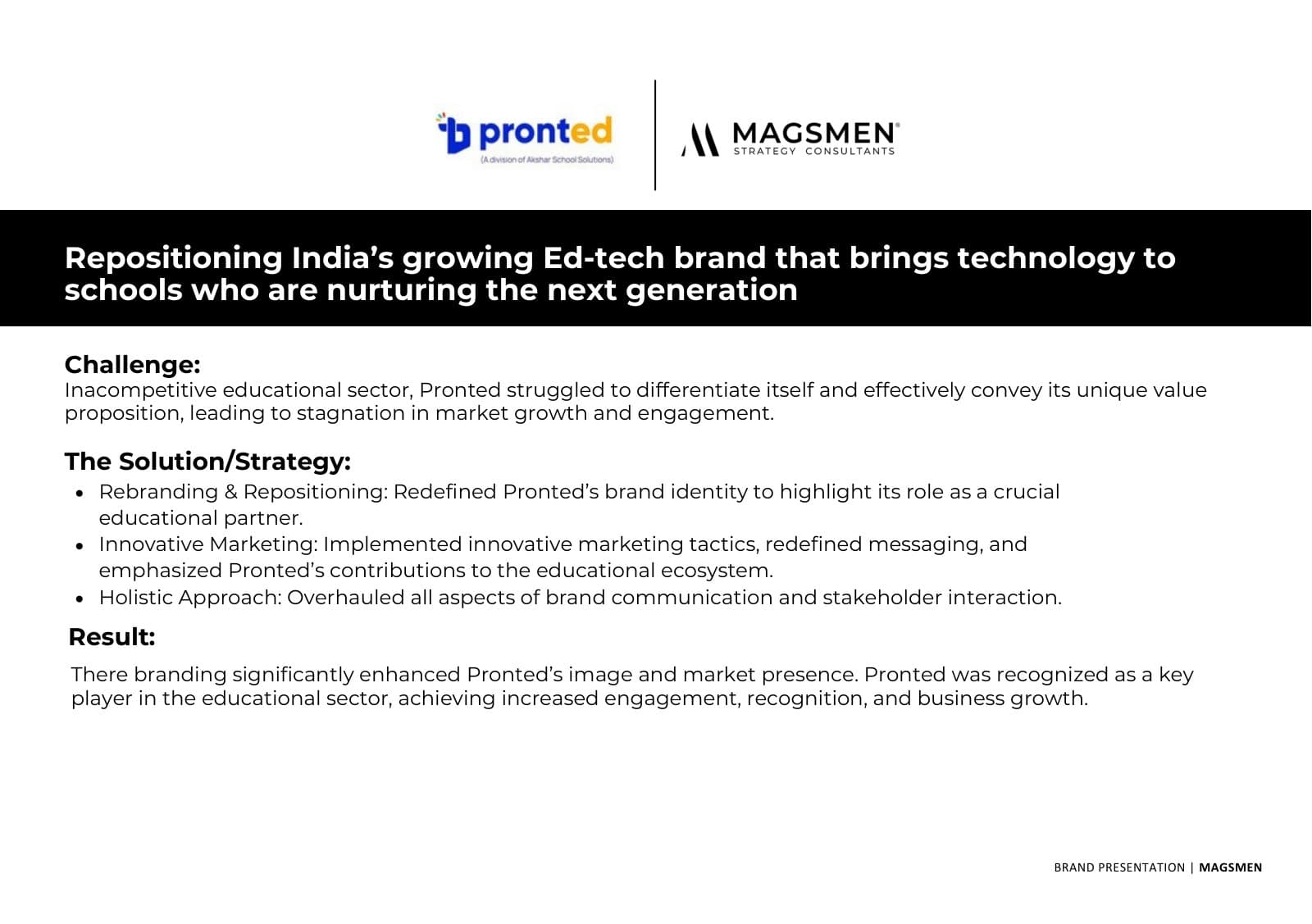
From one more vendor to a partner schools rely on.
- Client
- Pronted
- Category
- Ed-tech
- Engagement
- Repositioning and brand architecture
- Structure
- 4 phases

01The problem
What was actually broken
Pronted came to us as a technology supplier to schools, part of Akshar School Solutions. The product was good. Its place in the market was not clear at all. Indian education technology had filled up fast, every supplier promised digital transformation, and every pitch sounded the same. Pronted needed to become something schools could not replace, rather than something they swap for a cheaper option at the next renewal.
The product was never the problem. It worked. The problem was that schools and parents had no way to say why Pronted was better than the next name on the list. When a brand cannot explain its difference, price becomes the only thing left to compare. That is where Pronted was stuck.
As always, we did not take the client's version of the problem at face value. Pronted's leaders thought they needed better marketing. Two weeks in, we found something else. Their own team could not say why Pronted existed beyond a list of features. If the people selling it cannot explain the difference, no campaign is going to fix that.
Friction 01
No language for the difference
Institutions and parents had no way to explain why Pronted mattered more than the next vendor on the list.
Friction 02
Price as the only variable
When a brand cannot explain its own difference, the market defaults to cost as the only thing left to compare.
Friction 03
No shared internal narrative
The team selling the brand had no confident answer to why Pronted existed beyond the product feature list.
Friction 04
Categories blurred under one name
Several distinct service categories ran under a single brand with no individual positioning for any of them.
Four forces pressing on the same brand at once. Not one of them is a design problem, which is why not one of them is answered with decoration. The engagement exists to move the brand in a single direction against all four.
02The thought process
Why the sequence ran this way
To see the gap clearly, we built an internal portal for Pronted's own staff: a survey of what they really thought about the brand, the operations and where the company stood. Not a customer survey. A mirror. The results were blunt. There was no shared story, no clear position for any of the separate services, and no confidence in what should have been the strongest thing about the company, the value it gave schools.
Two branches run from the same question, and they run together rather than in turn. The engagement converges into a finished position only once both of them have answered.
03The strategy
Four phases, each giving the next something solid.
Sequential, each with its own deliverable. Nothing here ran open-ended.
Phase 01
Internal Discovery
We ran the survey across the leadership team and the wider staff, mapping where confidence existed and where it did not. That gave us facts to build on instead of assumptions.
Phase 02
Category-Level Positioning
Pronted sold several different services under one name. We gave each one a clear job to do, so every service adds to the same brand while still answering a real need on its own.
Phase 03
Foundational Realignment
We rewrote Pronted's vision, mission and values from scratch to match the new direction, so they landed with the team inside the company first and the market second.
Phase 04
Market-Facing Rebuild
Only once the inside was solid did we build the outward identity and messaging, putting Pronted forward as a partner schools rely on rather than one supplier among many.
Four phases run in sequence, each handing the next something solid to build on. The fill deepens across the row because the commitment does: nothing in a later phase is decided before the phase before it has answered.
Every phase was tested against whether Pronted's own people could carry it. The internal narrative was not a phase, it ran underneath all four.
Sequence
The 90-day engagement gave Pronted clarity before it gave Pronted a campaign, and that order is the entire reason the repositioning held.
04The ecosystem
How the phases relate
This is the difference between structure and decoration. We did not start with a new logo. We finished with one, after the team could say clearly what Pronted was. Every message and every point of contact was rebuilt around one idea: Pronted is not a supplier schools use, it is a partner schools depend on.
The pipeline shows the order the phases ran in. This shows why they were never four separate projects: each phase is a different surface of the same brand, and every one of them faces the same market.
05The outcome
What changed, and why it matters
Pronted went from one option among many to a name schools and parents saw as central to how the school runs day to day. Engagement went up. Recognition went up. The business grew, because the brand finally explained why Pronted mattered before anyone talked about price.
The 90-day engagement gave Pronted clarity before it gave them a campaign, and that order is why it held. When the people inside believe the story, nobody has to re-explain the brand every sales cycle.
A shared internal narrative, confirmed before any external work began.
Individual objectives defined for every service category under one identity.
Vision, mission and values rebuilt to match the new strategic direction.
External identity, messaging and communication rebuilt around one idea.
Recognition as a partner schools depend on, not a vendor schools use.
Growth driven by the brand explaining itself before price was discussed.
Each row moved from an unresolved state to a resolved one. Nothing on the left was decorative, and nothing on the right is cosmetic.
If your business is good but invisible in a crowded market, the answer is not more marketing spend. It is a position people cannot ignore, built from the inside out.
Other engagements.
The whole library













We don't add busywork; we eliminate friction. We partner directly with founders to replace boardroom guesswork with executable, profitable direction.