
FMCG, Andhra Pradesh
Tenali Double Horse
Revenue grew from 200 crore to 600 crore.
- Client
- Tenali Double Horse
- Category
- FMCG
- Engagement
- Long-running clients
- Structure
- 4 phases

- On recordRevenue up threefold
- On recordFour brands acquired
- On recordGroup formed
- On recordUS entry via Amazon
01The problem
Growth without a structure
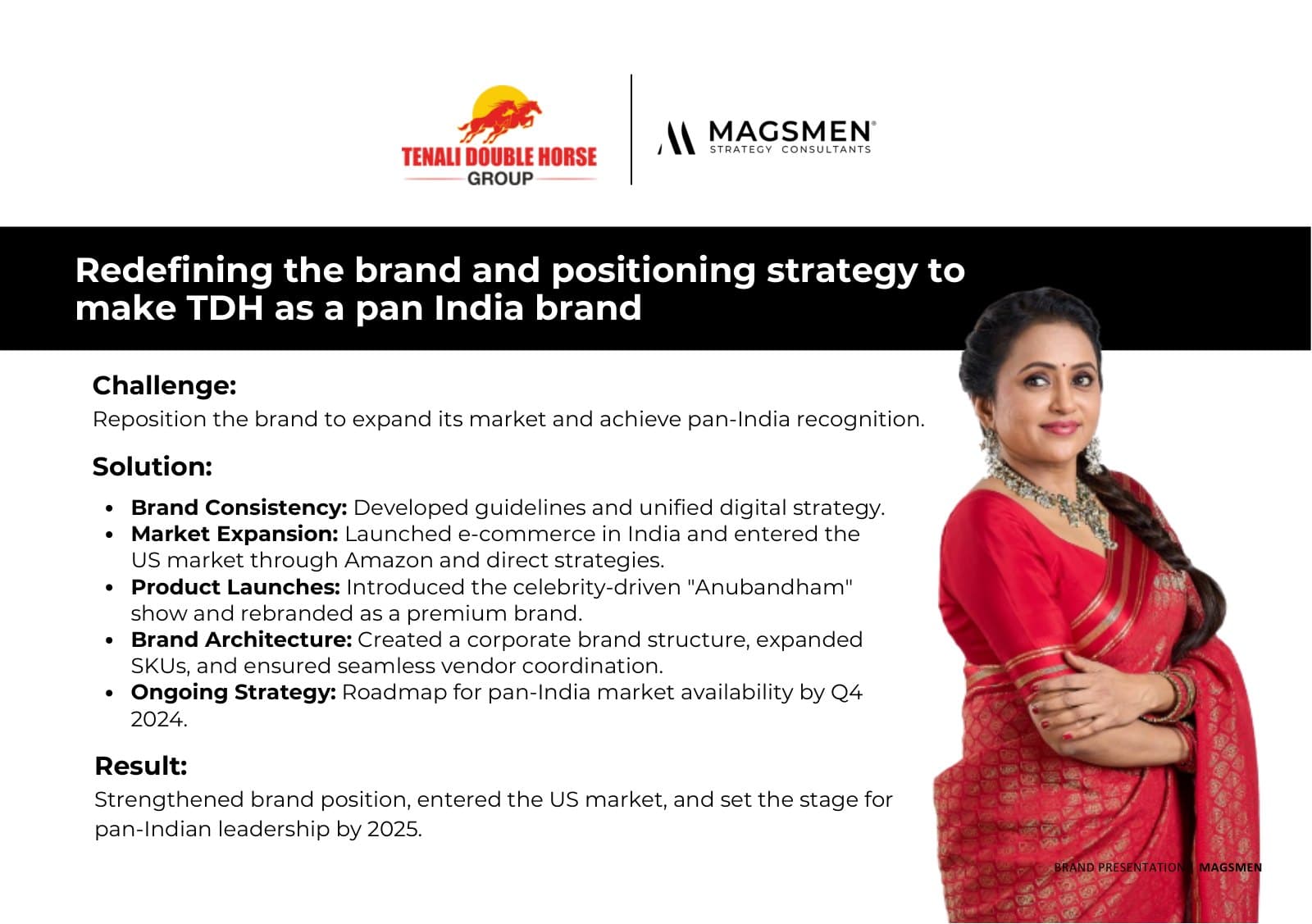
Tenali Double Horse had grown faster than its brand. Revenue stood near 200 crore. Twelve product lines sat under one name, and each spoke in its own voice. Only one thing held them together, and that was the chairman. His credibility carried the whole range. That works for a time. It fails at scale, because a brand that lives in one person cannot be handed to a distributor, a market or an investor.
The category made it harder. Staples are bought on habit and watched on price. A brand in that position has two ways to compete. It can cut the price again, or it can give the customer a reason to stop comparing. Cutting the price was already happening. Every quarter without one made the next discount more expensive.
A group that plans to acquire brands faces a second and harder question. How will those brands relate to each other, and to the name that sits at the top? That decision has to be made before the first acquisition, not after the fourth. Without one system that a new brand can enter without weakening the others, every acquisition adds confusion before it adds revenue. The structure had to come first.
Friction 01
Twelve lines speaking twelve ways
Each product line made its own claim, so the customer never got one clear reason to trust the range at once.
Friction 02
The chairman was the brand
His credibility held the range together. But credibility held by one person cannot be handed to a distributor, a market or an investor.
Friction 03
Habit and price decide the shelf
Without a reason to stop comparing, the brand was defending its margin slowly, one discount at a time.
Friction 04
Acquisitions needed a system first
A group that buys brands needs a structure that new brands can enter without weakening the rest.
Four pressures sat on one brand at once. None of them was a design problem, so none could be answered with a logo or a campaign. The work had to move the brand in one direction against all four, beginning with structure.
02The thought process
Why we sequenced it this way
We began with one question. What is the brand promising, and who is it promising it to? Only when that answer fitted in one sentence did we touch the twelve product lines. Acquisitions came after the architecture, so new brands entered a working system. The group entity came last, when there was something to hold.
Two decisions ran together, not one after the other. The promise and the structure were settled side by side. The group moved forward only once both had an answer.
03The strategy
Four phases, each one making the next possible
Each phase closed with a deliverable, and nothing ran open-ended.
Phase 01
A Single Story Defined
We defined one position for the brand, so every product line could speak from the same place. Everything after it stood on this foundation.
Phase 02
Twelve Lines, One Architecture
We built one architecture across the range. Each of the twelve lines received a clear, simple role, so the customer met one brand instead of twelve.
Phase 03
Four New Brands Brought Inside
Four brands were acquired and brought into the same system, so each one gained the strength of the group without losing its own customers.
Phase 04
A Group Entity
A formal group entity was created, giving the brand a structure no single person has to hold.
The phases ran in sequence. Nothing in a later phase was decided before the earlier one had answered. The position came first, then the architecture, then the acquisitions, then the group, and each step made the next cheaper.
The group did not appear at the end. It was shaped from the first phase, so that when it was formed, it only had to be named.
Structure over campaign
Revenue is the visible result, easy to quote. The structural result is that the brand no longer waits on one person to hold it together. A buyer, a distributor or an investor looks for exactly that first.
04The ecosystem
How the phases connect
The phases were never four separate projects. Each one worked on a different surface of the same brand. The position gave the range one voice. The architecture gave each line its role. The acquisitions showed the architecture could take weight. The group gave all of it a legal and commercial home that no single person has to carry.
The pipeline shows the order. This shows why the phases never stood apart. Each one faces the same market, and each strengthens the brand core at the centre, so the whole is worth more than the parts.
05The outcome
What changed, and what it means
Revenue grew from about 200 to 600 crore, and valuation roughly tenfold, in five years. The brand now has one position and a group behind it.
A business that has grown through relationships and hard work often has market presence and fragile foundations. One sharper competitor, one leadership change or one difficult year can undo what took a decade. Tenali Double Horse had the presence. The work was to build the structure underneath it while the business kept growing, without pausing the growth to do it.
Revenue grew from about 200 to 600 crore.
Valuation grew roughly tenfold over the five years of work.
Four brands acquired and brought into one system.
A formal group entity created to hold the whole structure.
Twelve product lines now speak from one position instead of twelve.
A brand no longer dependent on one person to hold it together.
Each row moved from fragile to structural. The numbers on the right are the visible part. The structure behind them is the real result.
Growth without structure is just noise. Tenali Double Horse built the structure while the growth continued, and never once paused.
“From introducing a new phase of Tenali Double Horse to managing time effectively and being transparent with us every step of the way, they have truly exceeded expectations.”Krishna Prasad N.V, General Manager
Other engagements.
The whole library
















We don't add busywork; we eliminate friction. We partner directly with founders to replace boardroom guesswork with executable, profitable direction.